The starting point: When traditional work is not enough to make ends meet
Som Bahadur Chepang, a 33-year-old smallholder farmer from Gorkha, Nepal, is a prime example of the socio-economic vulnerability of rural producers. Despite working tirelessly on his small plot of land, measuring just 2 ropani (approx. 1,000 m²), his livelihood was characterized by extreme insecurity for over a decade. The purely conventional cultivation of vegetables did not provide a stable livelihood, as it left the farmer unprotected against market forces.
The following table analyses the structural barriers that hindered Som Bahadur’s economic progress:
| Challenge | Economic cause | Consequences for the family |
| Limited land area (2 Ropani) | Lack of economies of scale | Limited capacity for subsistence farming and surplus for the market |
| Market volatility | Lack of storage capacity for cucumbers and beans; selling below value during harvest surpluses. | Despite good harvest yields, the proceeds were not sufficient to cover fixed costs. |
| Mono structure | Total dependence on perishable vegetable varieties. | Crop failures or price crashes led directly to insolvency. |
| Debt spiral | Lack of liquid reserves for emergencies. | Need to borrow from neighbors; increasing interest rate pressure. |
The core problem was not a lack of hard work, but the inability to preserve value. Whilst his cucumbers and beans had to be consumed quickly or sold at rock-bottom market prices, there was no ‘buffer asset’. Hard work without strategic diversification and access to stable tangible assets often leads to a vicious circle that cements poverty across generations.
The turning point: Targeted investment and knowledge-building
The transformation began with an intervention by the Tara Namaste Foundation, which went beyond mere charity and focused on strengthening human capital. The approach was based on three complementary pillars:
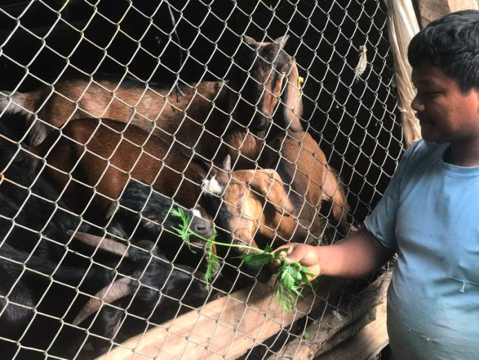
- Materials: Provision of building materials for a hygienic and functional goat shed.
- Start-up capital: Provision of a goat as ‘biological start-up capital’ to initiate a breeding cycle.
- Technical training: Comprehensive training in modern animal husbandry and resource management.
A striking example of the ‘so-what effect’ of this training is the production of mineral blocks from local resources. From a technical perspective, this is a highly effective intervention: prior to the training, the goats suffered from what is known as pica syndrome – a condition characterized by licking soil and mud due to mineral deficiency. This leads to parasitic infestations and growth disorders. The mineral blocks remedied this deficiency; the animals became more resilient, grew faster and reached sexual maturity on schedule. Local knowledge trumps pure capital here, as it reduces operating costs and promotes self-sufficiency.
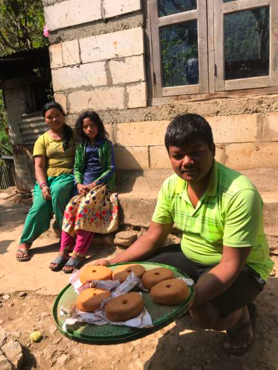
Som Bahadur reflects on this learning process:
“I learnt modern goat-rearing techniques and how to make mineral blocks from local resources. Now my goats are healthier, and I earn an income from breeding them.”
This solid knowledge base enabled the transition from mere animal husbandry to strategic livestock farming.
The concept of the ‘living bank account’
The metaphor of the goat as a ‘living bank account’ is central to the economic resilience of poor families. Unlike vegetables, which must be sold immediately when market prices are low, the goat acts as a ‘store of value on legs’. The value of the herd grows through natural reproduction and biological growth, regardless of daily market fluctuations.
The process of reinvestment and scaling followed a strict entrepreneurial logic:
- Avoiding immediate consumption: Rather than slaughtering or selling the first offspring to meet short-term consumption needs, the herd was consistently preserved.
- Targeted herd expansion: The application of new knowledge drastically reduced the mortality rate of young animals.
- Growth through reinvestment: Proceeds from partial sales were used to purchase additional animals and improve the herd’s genetics.
- Successful scaling: Within just two years, Som Bahadur built up a herd of eleven animals (nine females, two males) from a single goat.
With an annual income of over NPR 40,000 from goat sales, he has created a stable second source of income. His key conclusion is:
“When vegetable prices are low, I still have my goats. My goats are my bank. For poor families, goats are like a savings account.”
The Dividend of Security: Education and Diversification
Financial stability is not an end, but a catalyst for social development. The most important return on this investment is securing an education. Som Bahadur’s two children now attend the state school regularly, as the running costs are no longer covered by occasional loans but by profits from breeding.
An often-underestimated socio-economic factor is the preservation of family unity. Before the project, Som Bahadur was considering leaving his home to work as a migrant labourer in the city or abroad – a step that often leads to alienation and social instability. Success on his own land prevented this migration.
The security he gained boosted his self-confidence and enabled further diversification:
- A successful fresh start: He planted 300 Akabari chilli plants.
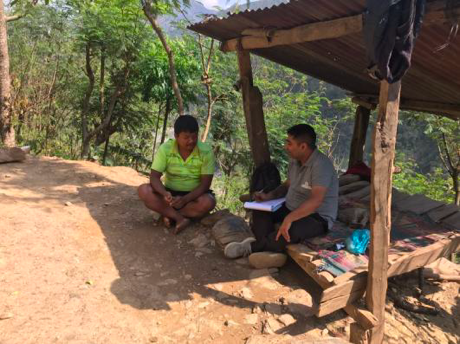
- The follow-up factor: Whilst an earlier attempt failed due to a lack of knowledge and motivation, this time the Foundation’s ongoing support – through field visits and telephone advice – ensured success.
True livelihood security means having the freedom to make long-term decisions without the paralyzing fear of where the next meal will come from.
Lessons for practice: What learners can take away from this case
The case study of Som Bahadur Chepang offers universal insights for sustainable development projects:
- Knowledge before capital: Material aid comes to nothing without the necessary know-how. Addressing the mineral deficiency (pica syndrome) through local knowledge was the real driver of growth.
- Wealth creation rather than consumption: Forgoing short-term liquidity in favor of building up a herd (‘savings account’) is the basis for prosperity.
- Monitoring as a guarantee of success: It was only through regular field visits and follow-up support that an unstable experiment was transformed into a sustainable business model (example: chilli cultivation).
- Social resilience: Economic success secures the livelihoods of local families and prevents risky labor migration, thereby strengthening the region’s social capital.
Som Bahadur’s journey impressively demonstrates that the transition from ‘getting into debt’ to financial independence is no coincidence, but rather the result of a combination of strategic resource management and continuous professional support.