The Burden of One’s Origins and a Glimmer of Hope
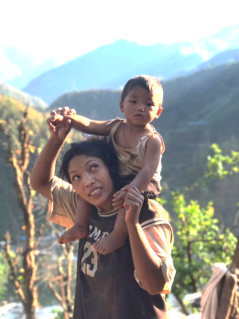
For a long time, Kabita Kumal Chepang’s life seemed to be predetermined by the structural limitations of her homeland. At just 23 years of age, the young woman from Burtibang in Baglung District looks back on an educational journey that was abruptly cut short by abject poverty. Although she attended school up to Year 10, a lack of financial resources forced her family to take her out of school – a fate that often nips the potential of an entire generation of young women in Nepal in the bud. About five years passed after she left school before Kabita got married. Two years ago, she finally moved into her husband’s house. There, however, she did not find a fresh start, but rather a continuation of the familiar hardship. She found an old house whose resources were barely enough to survive on. Her husband was forced to try his luck as a casual laborer far from home, whilst Kabita remained behind with her elderly parents-in-law. The family’s barren land lay fallow or was farmed by strangers, as the household lacked the strength and resources to cultivate it. “I was sad and often wondered why I had married into such a difficult situation,” recalls Kabita. Amidst this resignation, one crucial question stood out: how could a single goat, combined with the right knowledge, provide a way out of chronic dependency?
The multiplier effect: Why a goat is more than just an animal
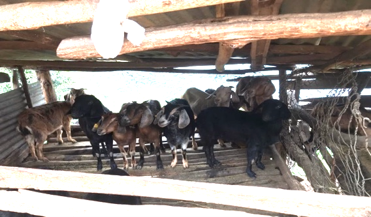
The turning point in Kabita’s life began with a small, strategic helping hand. Whilst her mother gave her first goat, the Tara Namaste Foundation provided a second young goat as part of its livelihood program. In development economics, small livestock herds are regarded as ‘living savings accounts’: They are resilient, ideally suited to the challenging terrain in Baglung, and, thanks to their reproduction rate, offer a natural form of compound interest. Through consistent care and the use of efficient breeding methods, the herd grew rapidly within a short space of time. What started as a pair has now grown into a sizeable herd, providing Kabita with a completely new economic foundation. “I now have three female and five male goats. I would like to expand my goat shed and increase the number of animals further.” This low-threshold approach is so effective because it enables women to become productive directly within their home environment. What was once purely a subsistence economy has become a micro-enterprise; Kabita now confidently sells her surplus produce at the local market.
Knowledge as the most important asset: Beyond mere distribution
Material aid alone often proves ineffective if it is not accompanied by education. Although Kabita possessed basic traditional knowledge of vegetable growing, it was only through targeted training that she was able to raise her productivity to a professional level. The foundation therefore consistently invested in building human capital. The training focused on:
- Modern goat farming: Advanced techniques for breeding, pen hygiene and keeping the animals healthy.
- Efficient agriculture: Methods for increasing yields on barren soils, taking climatic conditions into account.
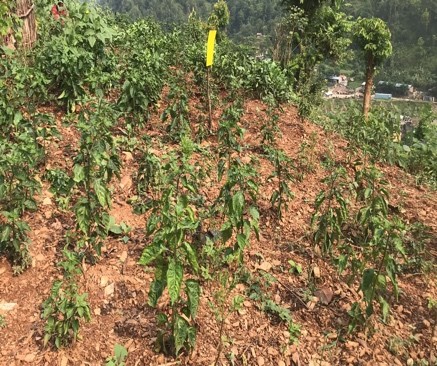
- Kitchen gardening: The establishment and optimization of kitchen gardens to ensure the family’s nutritional needs are met and to generate market revenue.
The Architecture of the Future: The Power of the First 1,000 Days
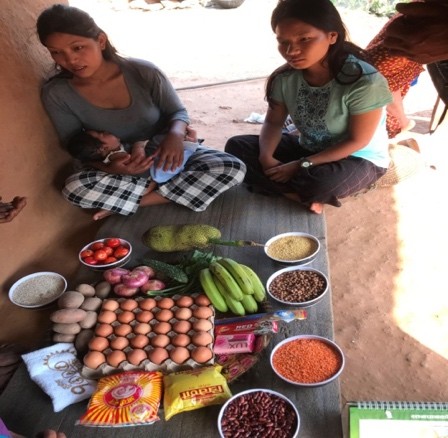
A central aspect of Kabita’s transformation is the realization that economic stability is inextricably linked to the health of the next generation. Through the ‘Poshan Nanglo’ program, she learnt about the critical importance of the first 1,000 days in a child’s life. This knowledge of nutrition, hygiene and breastfeeding practices forms the foundation for breaking the vicious cycle of poverty in the long term. Her six-month-old baby is now being cared for according to modern standards: in addition to breast milk, the baby receives targeted complementary foods and is taken to the health center in Beltar every month for growth monitoring. “I don’t want my child to face financial difficulties or must drop out of school because of a lack of money, as happened to me. That’s why I work hard every day for my family and my child’s future.”
The shift in identity: from dependence to self-reliance
Her economic activity has fundamentally transformed the psychological landscape of Kabita’s life. Whereas she used to be almost entirely dependent on her husband’s irregular remittances, she is now a co-breadwinner. A key moment in this development has been the diversification of her income streams: alongside goat farming, she has carved out a lucrative niche in the market by growing Akabare chillies. Even though her total income is still modest at present, the quality of her life has changed radically. It is the predictability of her earnings and the autonomy she has gained in emergencies that fuel her newfound self-confidence. Kabita is no longer a passive recipient of handouts, but an active agent who plays a hands-on role in shaping her family’s dynamics.
The next hurdle: the reality of infrastructure
Despite the impressive progress, the path to complete self-sufficiency remains a challenge. Empowerment is not a one-off event, but an ongoing process that repeatedly comes up against structural limitations – in this case, the acute water shortage in the region. To scale up her farming and livestock rearing, Kabita is already planning the next logical step: the construction of a plastic-lined water reservoir for controlled irrigation. This concrete plan illustrates her changed mindset: she no longer waits for chance opportunities but identifies infrastructure gaps and actively seeks solutions to secure her independence.
A dream becomes a reality
The story of Kabita Kumal Chepang impressively illustrates what ‘Help to Self-Reliance’ means in practice. It is not about the short-term alleviation of symptoms, but about providing start-up capital combined with sustainable knowledge. A young woman who once resignedly questioned her difficult life situation has become a determined small business owner. The crucial question for the international community remains: how must aid be structured so that it does not create new dependencies, but instead empowers people like Kabita to take the long-term control of shaping their own future into their own hands?