Invisible Barriers of Education
In the global effort to achieve universal education, we often focus on textbooks, teacher training, and classroom infrastructure. However, for many children in the remote corners of the world, the most significant obstacle to learning isn’t a lack of books; it is the “invisible barrier” of hunger. When a child arrives at school on an empty stomach, the brain’s capacity to concentrate, participate, and retain information is fundamentally compromised. In the high-altitude villages of Nepal, this reality often means that even when a school is available, its classrooms remain half-empty.
In the village of Baltar (Ward No. 7) within the Gandaki Rural Municipality, the students of Shree Praja Jyoti Basic School face this barrier daily. Every child here belongs to the Chepang community, an indigenous and marginalized group that has historically relied on seasonal daily wage labor, subsistence agriculture, and goat rearing. Because this labor is inconsistent, many families endure chronic food shortages. This economic instability creates a heartbreaking choice: children often skip school because breakfast isn’t ready on time, or simply because it doesn’t exist at all.
This small institution, which serves 66 students from Nursery to Grade 3, faced a critical attendance crisis that threatened the future of the village’s youth. Rather than focusing solely on traditional curriculum improvements, the Tara Namaste Foundation looked beyond the school gates. They asked a pivotal, curiosity-driven question: What if the solution to poor attendance wasn’t found in a new syllabus, but in the community’s kitchens and farms?
Feeding the Body Feeds the Mind
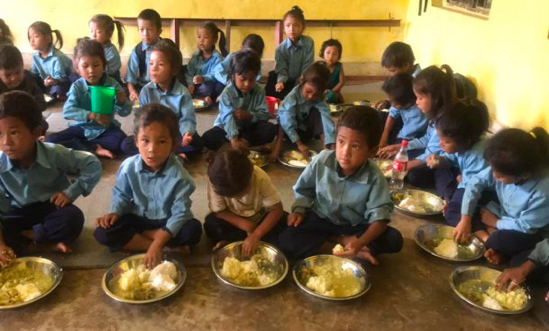
The program identified a direct, undeniable correlation between nutrition and classroom presence. Students weren’t skipping school due to a lack of interest or parental apathy; they were staying home because of the timing and availability of meals. To dismantle this barrier, the foundation began providing a daily nutritious morning meal for every student.
This intervention highlights a counter-intuitive truth in international development: the solution to improving grades often has nothing to do with more homework. By providing a hot meal, the school removed the primary driver of tardiness and absence. The impact is best summarized by Grade 3 student Anmol Chepang:
“The daily school meal gives me energy to study, and the English classes have helped me become more confident. I also enjoy playing games with my friends during school.”
Language as a Bridge to Confidence
Beyond physical nutrition, the foundation prioritized the quality of education by employing a specialized English teacher. For children from the marginalized Chepang community, who are often socially and economically isolated from the national mainstream, mastering a global language is about more than just vocabulary—it is about finding their voice.
Mastering English serves as a powerful psychological tool, transforming how these children perceive themselves. It builds a bridge of confidence that allows them to navigate a wider Nepalese society that has often overlooked them. By providing high-quality language instruction, the school isn’t just teaching a subject; it is equipping indigenous students with the self-assurance needed to advocate for themselves and their community in the years to come.
Livelihoods Beyond the School Gates: The “Goat Economy”
For educational gains to endure, a program must stabilize the household income supporting the student. However, Shree Praja Jyoti Basic School faced a specific challenge: it only provides education up to Grade 3. Once a child graduates, they must transition to nearby schools to continue their journey. This “Grade 3 cliff” is where many children drop out because their parents cannot afford the additional costs of continued education.
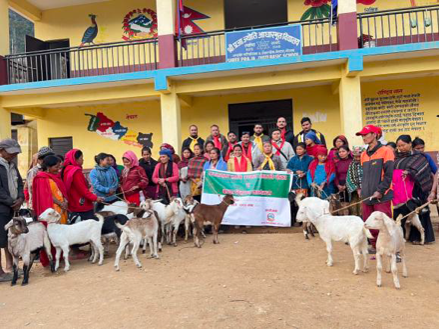
The “Goat Economy” was designed to bridge this gap. By providing families with livestock—specifically goats and chickens—alongside support for kitchen gardening, the foundation created a long-term financial engine. This livestock isn’t just for immediate food; it is a savings account on four legs. When a child finishes Grade 3, the income generated from commercial goat rearing and agricultural sales provides the financial bridge parents need to afford the transition to Grade 4 and beyond.
The Friday Prize: Incentivizing More Than Just Grades
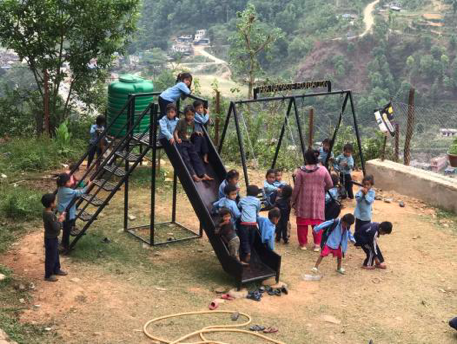
The school employs a “Weekly Reward Program” to motivate students to excel in areas that aren’t always captured on a report card. Every Friday, the school becomes a space of joy as prizes are awarded to a student from each class. This system is bolstered by the provision of sports and play materials—including swings and games—turning the school into a sanctuary for social development.
To win a “Friday Prize,” students must excel in:
- Regular attendance: Ensuring they remain consistent in their studies.
- Personal hygiene and cleanliness: Fostering health in a region with limited medical access.
- Good behavior and cooperation: Building a culture of mutual respect.
- Regular completion of homework: Strengthening academic discipline.
By rewarding hygiene and behavior alongside play, the school reinforces that personal character and well-being are just as vital as academic scores. Even holistic health is prioritized, with initiatives like organized “Eye Camps” ensuring that physical ailments never become a barrier to learning.
Community-Led Growth: Creating a Hyper-Local Circular Economy
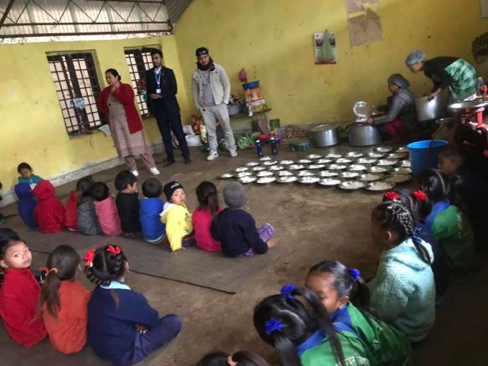
The program’s design ensures that the school serves as the heart of the community’s economic health rather than just a destination for aid. By creating three specific local jobs—one specialized English teacher and two kitchen staff members—the program keeps employment and expertise within the village of Baltar.
Furthermore, the foundation prioritizes the use of locally available food items and vegetables for the school meals. This creates a hyper-local circular economy: the foundation’s investment flows directly to local farmers, which in turn supports the very families whose children are eating the meals. This strategy reduces costs, supports local agricultural production, and ensures the program is built on a foundation of community-led growth.
Conclusion: A Holistic Path Forward
The transformation at Shree Praja Jyoti Basic School proves that education cannot exist in a vacuum. By addressing nutrition, language skills, and family livelihoods simultaneously, the program provides a blueprint for what truly “holistic” development looks like. It moves beyond the idea of a school as merely a place of instruction and reimagines it as a center for community health, economic stability, and social justice.
As we look toward the future of educational reform in marginalized areas, we must broaden our lens. When we redefine a school as a farm, a kitchen, and a community employer all at once, we stop just fixing schools and start transforming entire communities.